When you think of today’s best-perceived and most valuable brands, they share at least one common trait: consistency.
From its products to its advertising, Apple is sleek and modern. Google epitomizes search for meaning while Amazon is simply the store for everything.
No one is ever confused by what is offered from Netflix, Lowe’s, Samsung, Coca-Cola, or Microsoft – some of the most valuable or best known brands in 2016. It doesn’t matter if you see them on television, your smartphone, in your (snail) mailbox or (digital) inbox, on the web, or on a billboard. You recognize them – probably instantly.
Branding creates positive perceptions among targeted consumers, which influences the products and services they decide to buy, and how much they are willing to pay. Consider that Apple, the world’s most valuable brand in 2016, according to Forbes, still charges a premium for its iPhones, which account for nearly half of the smartphones sold in the U.S., despite an eroding distinction from other phones.
Good branding gives your customers a shortcut to purchase. If they already have a meaningful relationship with your brand, they are more likely to keep choosing it instead of considering other brands. So it is important that your brand be consistent.
Brand reinforcement
Remaining true to your brand across multiple – and emerging – channels and customer segments is the work of integrated marketing. At its most basic, integrated marketing communications (IMC) is defined as “an approach to achieving the objectives of a marketing campaign through a well-coordinated use of different promotional methods that are intended to reinforce each other.” Extended definitions – the Direct Marketing Association lists a page of them – add that integrated marketing must be customer-centric and create a unique and seamless experience for customers. IMC gives customers brand-consistent yet relevant messages at every point along their path to purchase.
Although the concept of integrated marketing has been around for decades, today it is applied as the “antidote to fragmentation” that can occur when marketers are trying to reach customers with targeted, specific communications at all different points along that purchasing path.
It is not for the faint of heart. “True integration means developing and communicating a consistent brand identity that can seamlessly transition from message to message, medium to medium, and platform to platform,” according to the Association of National Advertisers. “To fight fragmentation, everything a brand does to draw, convert, retain, and connect with customers should be integrated.”
The payoff is real, however, as integrated marketing can increase your customers’ engagement. Engaged customers buy 90 percent more frequently, spend 60 percent more per transaction, and are five times more likely to stay loyal to a brand, according to Rosetta.
The trick, then, is to engage customers. A survey of Biocompare.com visitors confirms that engaged customers are more likely to choose familiar brands. For example, the survey by Martin Akel & Associates found that, unsurprisingly, respondents who have previously done business with a vendor are 94% more likely to investigate that vendor’s offering first. The survey asked respondents various questions to determine how scientists learn about and acquire appropriate R&D tools and services.
The survey showed that buyers also value vendors they have not yet bought from, if they are familiar with them from traditional branding channels such as ads, newsletters sponsorships, videos, and so forth. Fully 80% said they are likely to investigate companies that have reached out to them via branded communications programs. Only 38% are willing to investigate brands they “are not really familiar with,” while just 30% considered brands they have never heard of.
The 9th Time is the Charm
Raising the consciousness of your prospects to your brand requires not only brand consistency, but also frequency and variety of marketing channels. The Akel survey found that visitors interact with an average of 5 different types of media on Biocompare.com, which influences their willingness to select a brand’s offering.
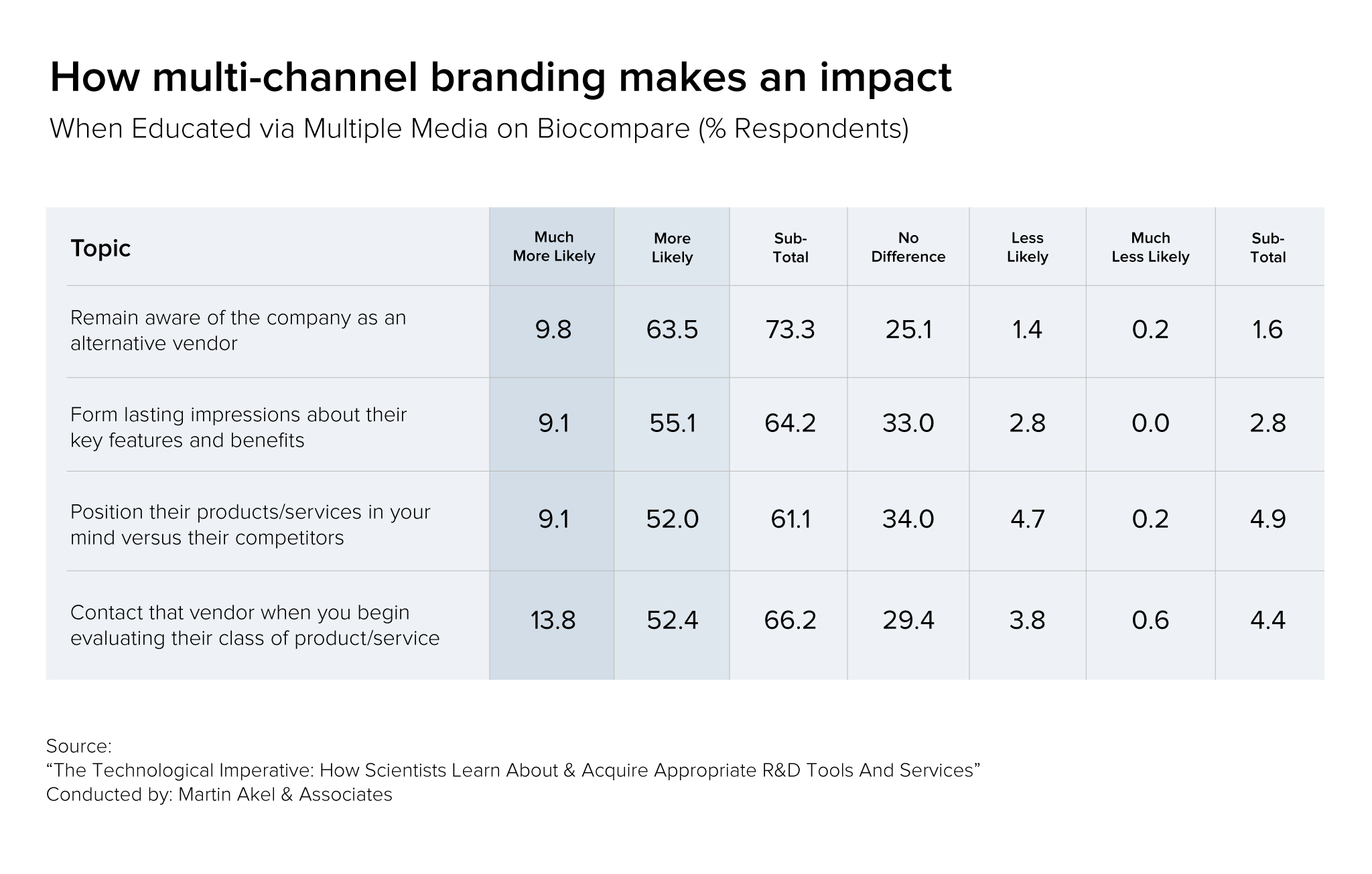
When a vendor uses multiple media assets on Biocompare.com, more than 73% of survey respondents said it helps them “remain aware of the company as an alternative vendor.” Nearly 65% said this helps form lasting impressions about key features and benefits. Sixty-one percent agreed multitouch, integrated campaigns help position the vendor’s product and services in the buyer’s mind, versus the vendor’s competitors, and 66% said they would contact the vendor with a multitouch campaign at the start of their product/service evaluation.
Multitouch, integrated marketing communications help move buyers through the product-adoption process, which includes four phases:
- Awareness
- Perception
- Positioning/differentiation
- Preference
Once buyers have identified a need and the general technological solution, Biocompare.com has been proven a powerful medium for driving prospects forward in all the phases of the product education and adoption process, relative to specific vendors and their products and services.
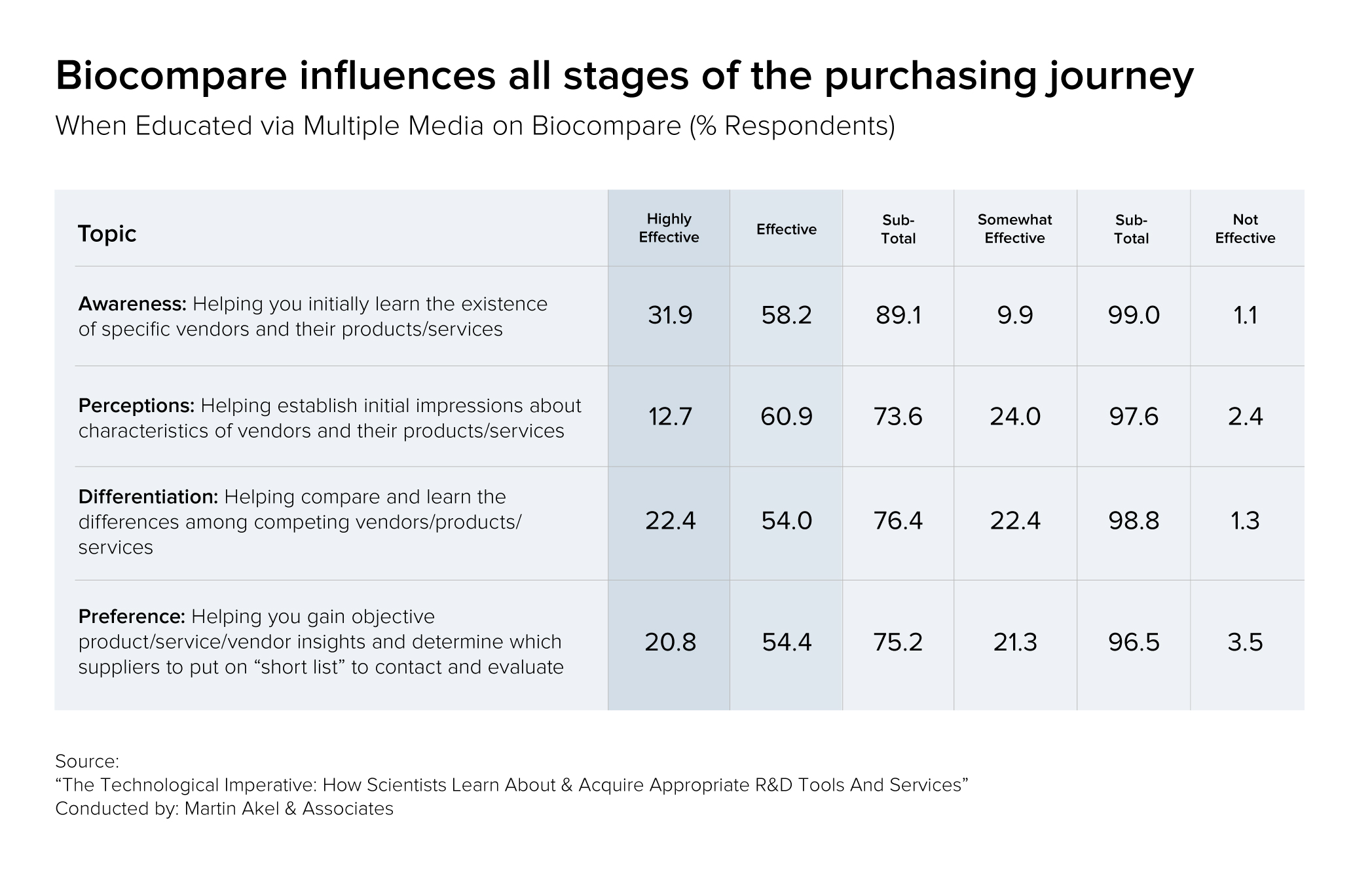
Nearly 90% of survey respondents said Biocompare was effective or highly effective in raising awareness, specifically in helping scientists first learn about the existence of specific vendors and their solutions.
More than 73% agreed that the site helps scientists establish initial impressions about the characteristics of the vendors; that is, creating perceptions about features, benefits, capabilities, etc. To distinguish products, 76% of survey respondents said Biocompare helps scientists compare and learn the differences between competing vendors and their products and services. Fully three quarters said they get help gaining objective insights to vendors and products and services, enabling them to determine which suppliers to put on a short list to contact and evaluate.
It is obvious that researchers place a high value on having a range of marketing media formats – from product listings and product reviews to webinars, videos, and newsletters – available to them as they learn about R&D tools and services they will need to acquire to perform their work.
Within the Biocompare site, visitors are likely to engage with the majority of the materials a vendor provides, and most decision-makers report they move more quickly through the brand adoption process when offered multiple, integrated marketing media.
Vendors wishing to reach and engage their target audience are wise to leverage multitouch integrated marketing programs, giving prospects ample opportunity to become familiar – and then comfortable – with them. At least enough to make the short list so you can demo your product or answer questions in a face-to-face sales presentation.
For assistance planning your integrated marketing campaign to reach Biocompare’s audience of highly qualified, highly engaged researchers and scientists, contact your sales representative. Or download to discover the multiple media and content formats available on Biocompare.com.